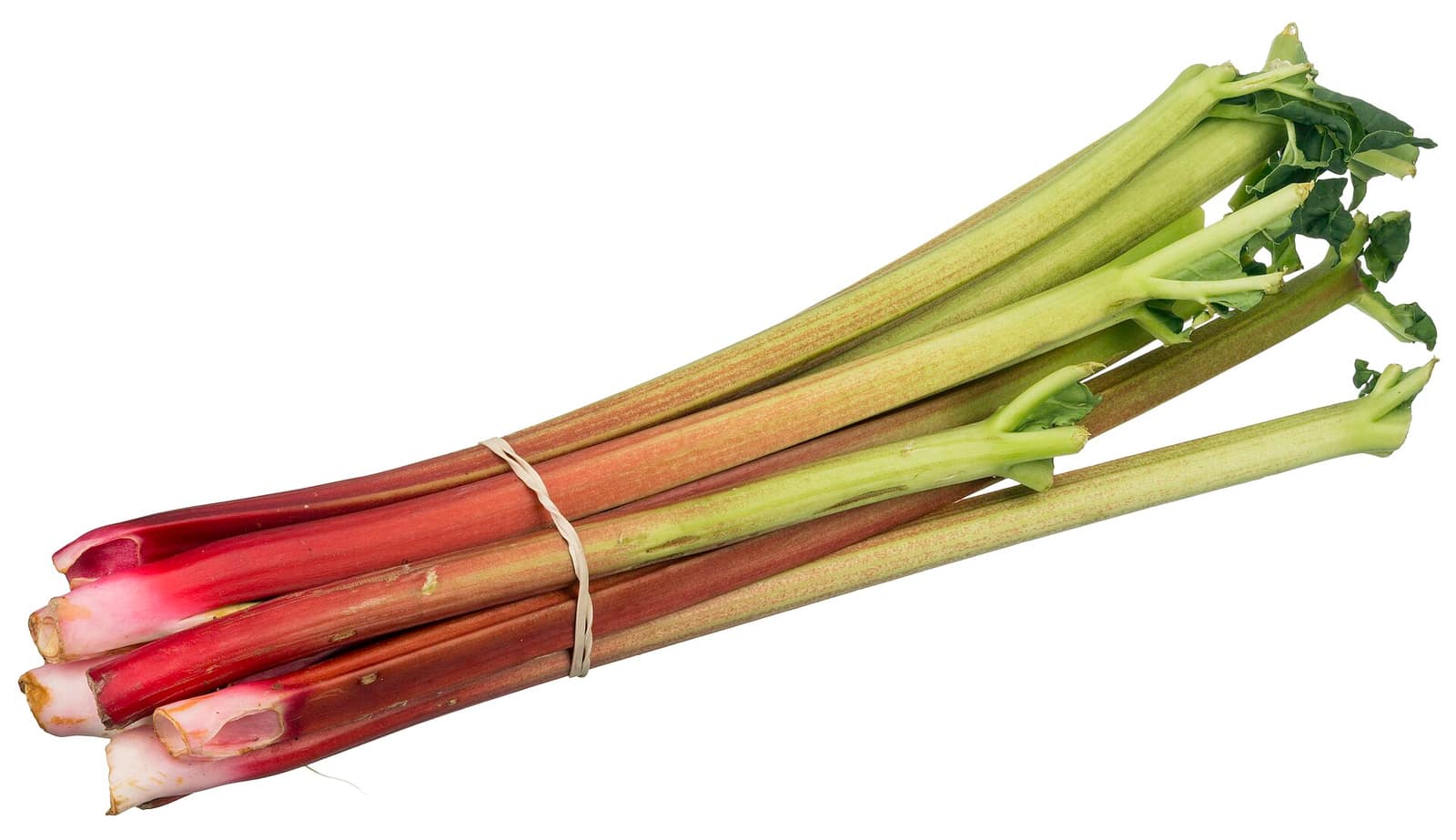

British rhubarb has two distinct seasons and a stretched middle. Forced stalks appear on greengrocers’ stands in January and sometimes earlier; maincrop rhubarb starts in April and rolls through to mid-summer; after about the end of June, the plant should be left alone. The rest of the year is for other fruit.
Here is the calendar, and a few things the calendar does not say.
Early January to late March: forced rhubarb
Pale pink, long, bendy stalks begin to show in mid-January, driven by the sheds of the Rhubarb Triangle and a smattering of growers elsewhere. The flavour is sharp but light; the stalks collapse quickly in the pan. Buy a bunch when you see them and use them for dishes that show off the colour and the quick cook: a fool, a sorbet, a pink panna cotta.
You can force a crown of your own at home, but not every year; see our growing notes.
April to mid-June: the maincrop
From mid-April, outdoor rhubarb in the garden begins to put up thick, red-and-green stalks that keep coming for six to eight weeks. This is the moment for jam, chutney and tray bakes; the fruit is cheap at the greengrocer, abundant in the allotment, and has enough acidity to stand up to sugar.
The RHS gives the main cropping window as April to late June in most of the UK; the RHS growing guide is worth a read for a longer view. Pulling is better than cutting: hold near the base of the stalk, twist and lift. The whole stem including the white foot comes away cleanly.
Late June onwards: stop
By the last week of June, the plant is ready for a rest. Picking after this point weakens the crown for the following year and the stalks themselves become stringier and more acidic. Take only a few stalks from an established clump if you really need to; leave a young one entirely.
The folk advice about not picking after ‘Midsummer Day’ (24 June) is not far off. By the time the longest day has passed, the leaves are casting dense shade over the crown and the stalks will start to toughen.
Autumn and winter: nothing to pick
The leaves yellow and collapse in September and October. Do not clear them away: they insulate the crown. In November, pile a few inches of garden compost or well-rotted manure around (not over) the crown. The plant retreats below ground until midwinter; the first pink nose will push through in January.
How to pick a good stalk
- Thickness. A thumb across, give or take. Pencil-thin stalks are either very young or stressed; chunky, cob-like stalks are old and stringy.
- Colour. Depth is a matter of variety, not ripeness. A mostly green stalk can be perfectly sweet; a deep red one can be sour. Taste a sliver if in doubt.
- Firmness. The stalk should snap crisply, not bend. If it bends, it has sat on a shelf for too long and will be stringy in the pot.
- The foot. At the base, where the stalk met the ground, there should be a pale, slightly waxy bulb. This is the sweetest part.
Storage once you are home
Trim off any leaf still attached and discard it. Wash the stalks under cold water and dry them. Wrapped loosely in a clean tea towel and put in the bottom of the fridge, maincrop rhubarb keeps for a week. Forced rhubarb is more delicate and wants using within three days; the long stalks bend if left.
Rhubarb freezes well raw. Cut into 2 cm pieces, spread on a tray, freeze until firm, then bag. No blanching; no sugar. Use it straight from the freezer in a crumble or a jam; it will release a touch more liquid than fresh but the flavour is unchanged.
In the kitchen, through the year
If you only have enough garden space for one rhubarb crown, you can pull it four or five times between April and June, freeze what you cannot use, and have enough pink stalks in the freezer for a Sunday pudding most weeks until the following spring. Rhubarb rewards a steady hand rather than a rush; use what is on the plant now, and leave the rest to grow.