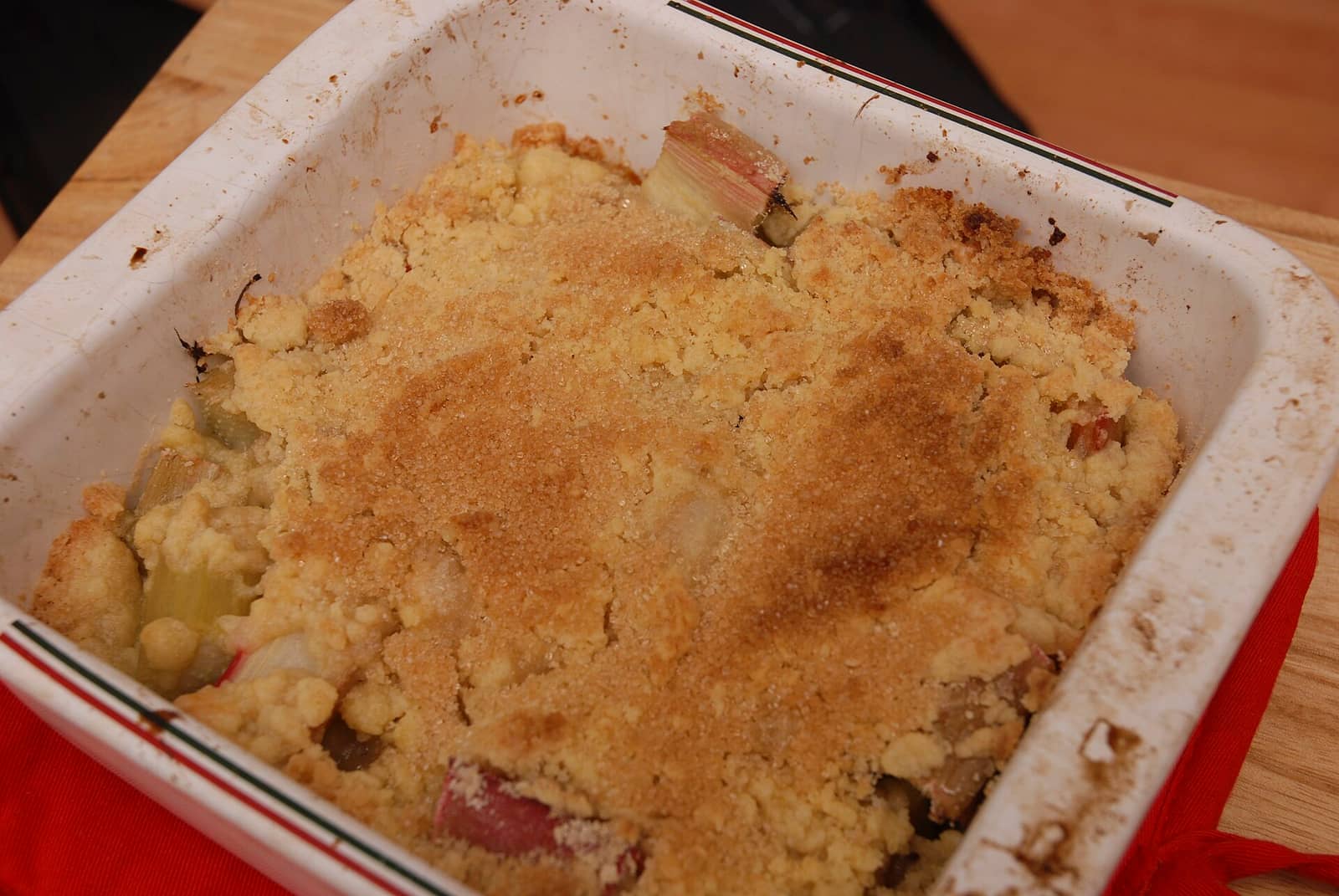

The short answer. For a crumble that serves four to six, you need about 700 g of trimmed rhubarb, 60 to 80 g of caster sugar for the fruit, and a topping made from 180 g plain flour, 110 g cold butter, 90 g demerara and a small handful of rolled oats. Bake at 190 °C fan for 35 to 40 minutes. Rest for ten.
Everything else in this piece is why those numbers work, what to change for forced rhubarb, and how to stop the base going swampy.
Rhubarb crumble
Serves 4 to 6 · prep 15 min · bake 35 to 40 min
For the fruit
- 700 g rhubarb, trimmed and cut into 3 cm lengths
- 60 to 80 g caster sugar, to taste
- Zest and juice of half an orange, or a teaspoon of vanilla paste
- A grating of root ginger (optional)
For the topping
- 180 g plain flour
- 110 g cold unsalted butter, in dice
- 90 g demerara sugar
- 30 g rolled oats
- A pinch of flaky salt
- Heat the oven to 190 °C fan (210 °C conventional). Butter a shallow dish of about 1.2 litres.
- Toss the rhubarb with the sugar and orange zest in the dish. Leave while you make the topping; the fruit will start to glisten and that is what you want.
- Rub the butter into the flour with cold fingertips until it looks like coarse breadcrumbs. Stir in the sugar, oats and salt. Squeeze a few small clumps so the crumble bakes with some chewy bits as well as sand.
- Scatter the topping over the fruit without pressing it down. Bake for 35 to 40 minutes, until the fruit juices bubble at the edges and the top is a deep gold.
- Rest for ten minutes before serving with cold cream, pouring custard or vanilla ice cream.
Why the ratios
Plain crumble is a one-to-two-to-three affair by weight: one part sugar, two parts fat, three parts flour. In practice, slightly less butter (close to one and a half) gives a drier, nuttier topping that stays crisp over custard. A tablespoon or two of oats lends chew and helps mask the slight oiliness some all-butter toppings carry when freshly baked.
The sugar in the fruit is the dial to watch. Maincrop rhubarb picked in May and June is sharp, with a touch of green in the stalks; it takes the full 80 g. Forced rhubarb from January to March is softer and already sweet, so 50 g is plenty. Taste a raw cut of stalk before you sugar it; you will know.
Stopping the dreaded wet layer
A soggy crumble is almost always too much liquid against too little topping. Three things help.
- Do not add water. Rhubarb is around 93 per cent water already; it will make its own syrup as it cooks.
- Macerate while you weigh out the topping. Fifteen to twenty minutes with sugar draws some juice out of the fruit, which thickens as it reduces in the oven.
- Use a shallow, wide dish. A deep pie dish keeps the fruit submerged. A 20 by 28 cm gratin dish exposes more surface area, lets the topping colour, and allows the juices to reduce.
Some cooks add a teaspoon of cornflour to the fruit. It works, but at the cost of a slightly gluey mouthfeel, and you do not need it with the oven at 190 °C fan.
Which flavours earn their place
Rhubarb is a willing partner. The ones worth keeping are pairings that add rather than mask.
- Orange. Zest in the fruit, a squeeze of juice before baking. The classic.
- Ginger. A thumb of grated root is sharper than ground ginger and vanishes into the juice. If you prefer the heat up front, chop two balls of stem ginger into the fruit and swap a tablespoon of the caster for the syrup. The ginger rhubarb cake uses the same thinking.
- Vanilla. A split pod or a half teaspoon of paste. Pairs with cream rather than custard.
- Hazelnut. Replace 40 g of the flour in the topping with ground hazelnuts and toast the topping blind for a few minutes if you like a deeper flavour.
Leave out: cardamom (fights the fruit), cinnamon (makes it taste of apple), strawberries in winter (they are not in season when the rhubarb is).
Forced rhubarb, maincrop rhubarb
The two stalks behave differently in the oven. Forced rhubarb is tender, holds its colour and collapses to a pale pink puree in about twenty minutes. Maincrop is firmer and needs the full forty to lose its bite. For a crumble you want some fruit that keeps its shape under the topping, so with forced rhubarb cut the pieces longer (5 cm) and start checking at thirty minutes.
For more on the difference, our piece on the Yorkshire forced rhubarb sheds explains why the stalks are so different in January.
Make-ahead and leftovers
The topping keeps raw in a lidded tub in the fridge for a week, and frozen for three months. Scatter it straight over fruit from the freezer; no need to thaw. The baked crumble reheats well: fifteen minutes in a hot oven, uncovered, revives the top. Microwaving turns the crust to cardboard; worth the extra time.
Any leftover fruit is good on porridge the next morning, or stirred through thick yoghurt with a spoon of the oat topping crumbled over the top.
A note on the stalks
Only the stalks are for eating. The leaves contain high levels of oxalic acid and should be composted or binned. If a pulled stalk has any leaf still attached, cut it off at the kitchen counter and wash the stalks only. For more on which stalks to pick, and when, see our guide to the UK rhubarb year.