
If you have ever wondered why a stick of rhubarb in February is pale pink, almost bendy, and tastes like a different plant from the leathery green stalks of July, the answer is a small patch of West Yorkshire and a trick that is roughly two hundred years old.
The Rhubarb Triangle is a nine-square-mile area between Wakefield, Morley and Rothwell. It still produces most of Britain’s forced rhubarb, and the stalks it sells from January to March have held Protected Designation of Origin (PDO) status since 2010. If a packet or an invoice says ‘Yorkshire Forced Rhubarb’, that is a legal claim about where it was grown and how.

What forcing actually is
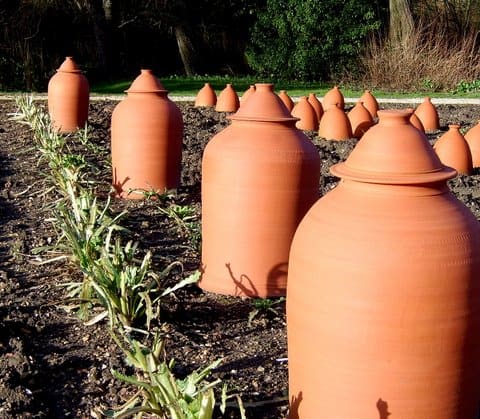
Rhubarb crowns build up starch reserves in their roots through the summer. If you starve them of light in midwinter, after they have had a cold snap to break dormancy, they put those reserves into tall, pale shoots that race upwards in search of sun that is not there. The shoots are tender and sharp rather than earthy, with the acidity turned down and the sugar concentrated in a thinner stalk.
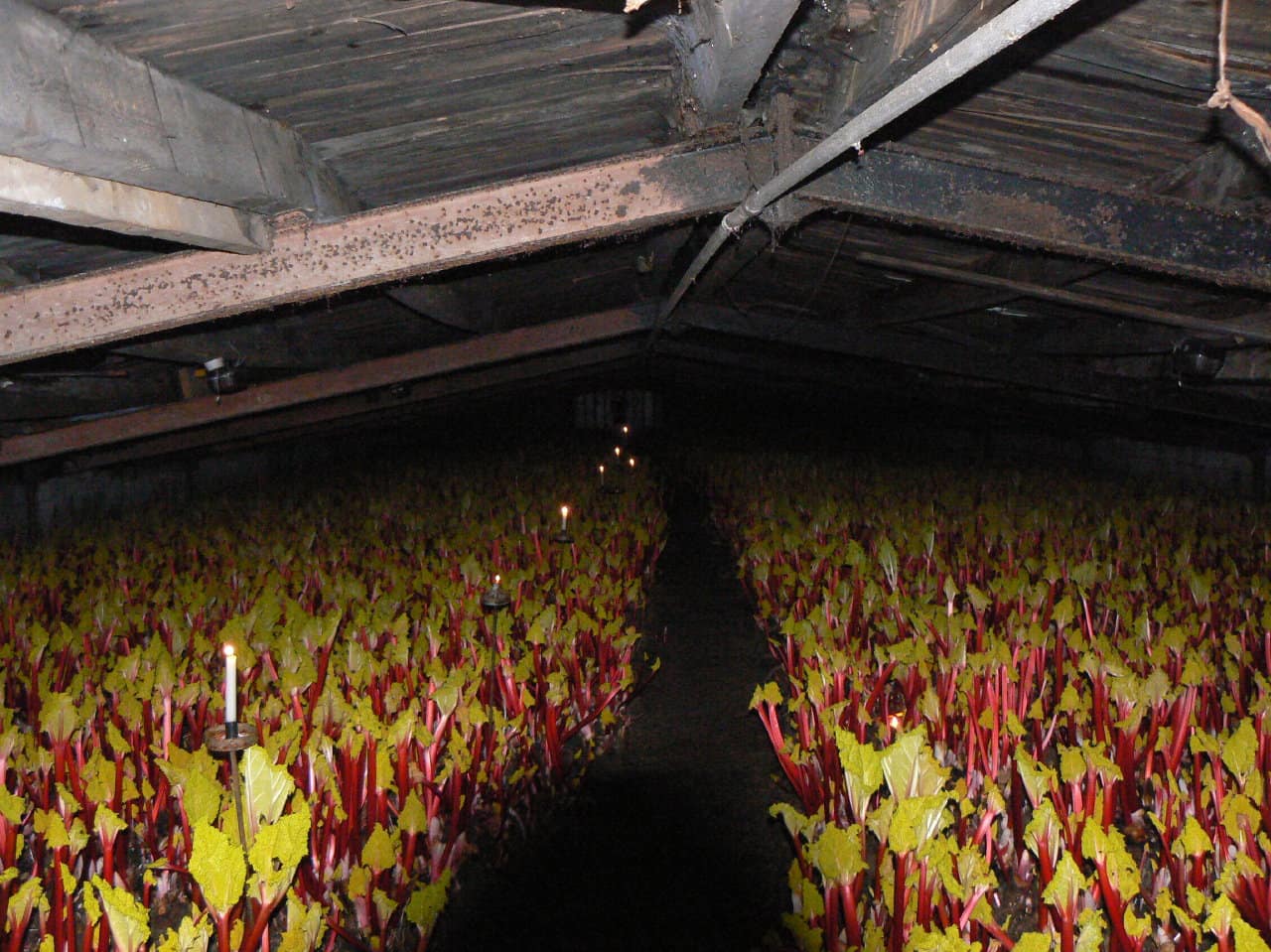
The Rhubarb Triangle growers do this at scale. Two-year-old crowns are lifted from the fields in November and left on the surface so that frost can act as the trigger. The roots are then moved into long, low sheds, warmed just enough to bring them on, and kept in total darkness.
The candlelight bit is not a marketing line
The sheds are dark because light slows the growth and toughens the stalk. Pickers work by candlelight or by a dim head torch so as not to check the crop. You can hear the stalks creak as they grow; the phrase is overused in press pieces, but it is true.
Each crown is picked once in a season and then either composted or replanted outdoors, where it needs two years to recover. Forcing is hard work for the plant, which is why the commercial sheds rotate roots in and out continuously through winter.
How the Triangle came to be
Three things lined up in nineteenth-century West Yorkshire. There was cheap woollen-mill shoddy and the horse manure of the pit villages, both of which built rich, deep soil. There was the smoke and fog of the industrial cities, which suppressed spring growth and made the trick of forcing more profitable. And there was the railway from Leeds to London, which could get a crate of fresh stalks to Covent Garden overnight.
By the 1930s there were around two hundred rhubarb growers in the Triangle and a weekly rhubarb express train. Today a handful of family growers remain, among them Oldroyd and Westwood, and the sheds are heated with oil rather than coal. The PDO was awarded by the European Commission in 2010 and has since been carried over into the United Kingdom’s own geographical indication scheme.
What it means in the kitchen
Forced rhubarb and maincrop rhubarb are not interchangeable, and treating them the same is why some recipes let you down.
- Colour. Forced is coral pink through the whole stalk. Maincrop is green at the base, flushed red up the stalk. If a recipe sells on the colour of its finished dish (a pink jelly, a sorbet), use forced.
- Texture. Forced stalks collapse in fifteen to twenty minutes of gentle cooking. Maincrop needs thirty to forty, and resists.
- Acidity. Forced carries less oxalic acid and feels less mouth-puckering. You can use a third less sugar than in a maincrop recipe of the same weight.
- Price. Forced is six to eight times the price of maincrop by weight. Save it for dishes where the texture and colour matter: panna cotta, poached stems over set custard, a simple compote on thick yoghurt. For a jam or a crumble, use maincrop.
Buying honestly
From January through March, look for ‘Yorkshire Forced Rhubarb’ on the label; the PDO wording is checked. Outside that window, any British rhubarb you see will be field-grown maincrop. A sign that simply says ‘forced rhubarb’ in November or December, with no origin, is more likely to be Dutch glasshouse stock than West Yorkshire; the stalks are longer, often paler and milder.
A short reading list, for later
Wakefield Council runs a rhubarb festival each February, and the sheds open for pre-booked lantern tours during the picking season; the pattern changes year to year, so check what is on before you travel. A group of Yorkshire artists, led by Martin Parr, photographed the Triangle in the early 2000s; his book of that project is still in print and gives a better sense of the places than any food writing.
What matters for the cook is simple: when your local greengrocer stacks the pale coral stalks in late January, buy a bunch for something that will show them off, and save your jam-making for the rowdy maincrop in May.