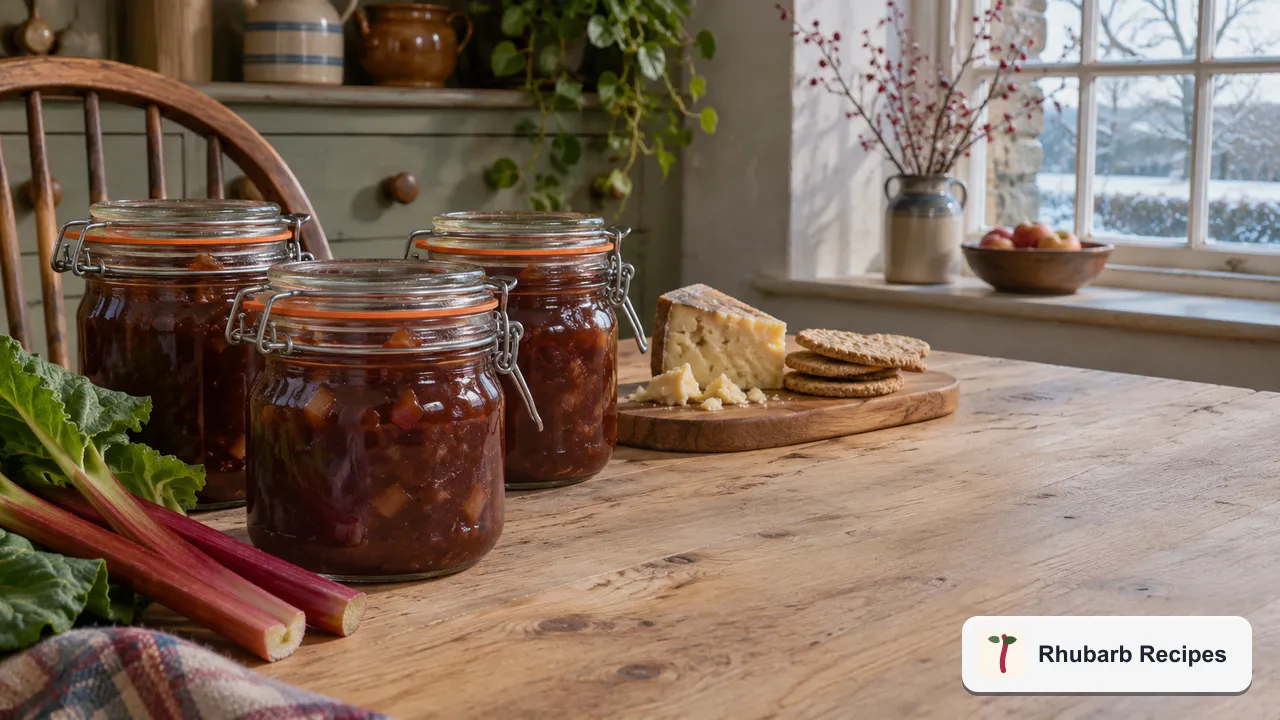
The short version. Rhubarb chutney made in the middle of November is at its best by the third week of December. Use 1 kg of rhubarb (frozen is fine), 2 onions, 150 g of raisins or chopped dates, 300 g of soft brown sugar, 300 ml of cider vinegar and a little warm spice. Simmer slowly for about an hour and a quarter until a spoon drawn across the pan leaves a channel that does not fill straight away. Pot into hot, sterilised jars, seal, and leave in a cool, dark cupboard for at least three weeks.
That rest is the whole reason for starting now. Freshly made chutney tastes harsh, all vinegar and sugar with the spice shouting over the top. A few weeks in the jar rounds it off, and by Christmas week the rhubarb has turned into something rich and dark that sits happily next to a crumbly Lancashire or a strong Cheddar.
Why rhubarb works on a cheeseboard
Most Christmas chutneys lean on apple, tomato or onion. Rhubarb brings a sharper, cleaner acidity that keeps its edge even after a long simmer with sugar. Against fatty, salty cheese that sharpness is exactly what you want. It also breaks down completely, so you get a soft, spreadable texture without any chopping at the end.
There is another practical argument. In November there is no fresh outdoor rhubarb, and forced stalks from Yorkshire do not usually reach the shops until the new year. If you froze a few bags in May or June, as we suggested in our note on the UK rhubarb year, this is the moment to use them. Frozen rhubarb is ideal for chutney because the freezing has already softened the fibres.
Spiced rhubarb chutney
Makes about 5 jars of 340 g · prep 20 min · cook 1 hr 15 min
- 1 kg rhubarb, cut into 2 cm pieces (fresh or frozen; no need to thaw)
- 2 medium onions, finely chopped
- 150 g raisins, or stoned dates chopped small
- 300 g soft light brown sugar
- 300 ml cider vinegar
- A thumb of root ginger, finely grated
- 2 cloves of garlic, crushed
- 1 tsp mustard seeds, 1/2 tsp ground allspice, 1/2 tsp ground cinnamon
- 1/2 tsp chilli flakes (optional) and 1 tsp fine salt
- Put the onions, vinegar, ginger, garlic, spices and salt into a wide, heavy pan (a jam pan is perfect; avoid bare aluminium or copper, which react with vinegar). Simmer gently for 15 minutes until the onion is soft.
- Add the sugar and stir until it has dissolved. Add the rhubarb and the dried fruit.
- Bring back to a bare simmer and cook, uncovered, for about an hour, stirring more often towards the end as it thickens and starts to catch.
- Test by dragging a wooden spoon across the base of the pan. When the line stays open for a second or two before the chutney slumps back, it is done.
- Spoon into hot sterilised jars right to the shoulder, seal with vinegar-proof lids while hot, and label with the date.
Getting the jars right
Chutney is acidic and sugary, which is what lets it keep, but the jars still need to be clean and sound. The Food Standards Agency’s guidance on providing food at community and charity events says it is safe to re-use glass jam jars occasionally, provided they are properly washed, free from chips and cracks, and sterilised before each use. That is good practice for jars that stay at home too.
Our routine: wash the jars and lids in hot soapy water, rinse, then stand the jars upside down on a baking tray in an oven at 140 °C for 15 minutes. Lids go into a pan of just-boiled water for a few minutes. Fill the jars while both they and the chutney are hot. The same routine works for our rhubarb and ginger jam.
Lids matter more for chutney than for jam. Vinegar corrodes bare metal, so use lids with a plastic coating on the inside. Old lids with any rust or a scratched lining are better thrown away.
The three-week wait, and how long it keeps
Store the sealed jars somewhere cool and dark. A cupboard on an outside wall or a garage shelf that does not freeze is ideal. Left unopened, a well-made chutney like this keeps for many months, and many cooks find it tastes best between three months and a year.
Once a jar is open it belongs in the fridge. The FSA’s advice on chilling and freezing food is that a home fridge should run between 0 and 5 °C, and it is worth checking yours with a thermometer before the Christmas shop fills it up. Use a clean spoon every time and an opened jar will see you through the holidays and well beyond.
Variations worth trying
- Rhubarb and fig. Swap the raisins for 200 g of dried figs, chopped, and add a few crushed fennel seeds. Very good with blue cheese.
- Rhubarb and orange. Add the grated zest of two oranges with the sugar and the juice in the last ten minutes. Brighter and fresher; a good match for ham.
- Hotter. Double the chilli and add a teaspoon of black onion seeds. Excellent in a cold-meat sandwich on Boxing Day.
- Less sweet. You can drop the sugar to around 225 g, but the chutney will be sharper and a touch looser. Keep it in the fridge once opened and use it within a few weeks.
What to put it with
A wedge of crumbly Lancashire or Wensleydale is the natural partner: the sharp fruit and the clean, milky cheese make a good pair. A mature Cheddar, a soft goat’s cheese or a slice of Stilton all work too. Beyond the cheeseboard, try a spoonful with pork pie, cold turkey, a ploughman’s or a sausage roll straight from the oven.
Rhubarb chutney also makes a good small present. A plain jar with a fabric top and a handwritten tag takes it most of the way. If you plan to sell any rather than give them away, read our separate note on selling homemade jam at a Christmas fair first, because the rules change once money is involved.
When it goes wrong
Too runny. It was taken off the heat too soon. Tip it back into the pan and simmer for another 10 to 15 minutes, then re-sterilise the jars.
Burnt taste. It caught on the bottom in the final stage. There is no fixing that; the scorched flavour runs right through. Next time use a heavier pan and stir constantly once it thickens.
Liquid on top after a few weeks. A little separation is normal. Stir it in when you open the jar. Mould, a fizzy smell or a bulging lid are different: throw the whole jar away.
Still harsh in December. Usually a sign it was made too late or the vinegar was very strong. It will keep improving into the new year, so put one jar aside and try it again at Easter.
If you make one preserve this month, make this one. It uses up the freezer, costs very little, and gives you something to open on Christmas Eve that tastes of last summer.