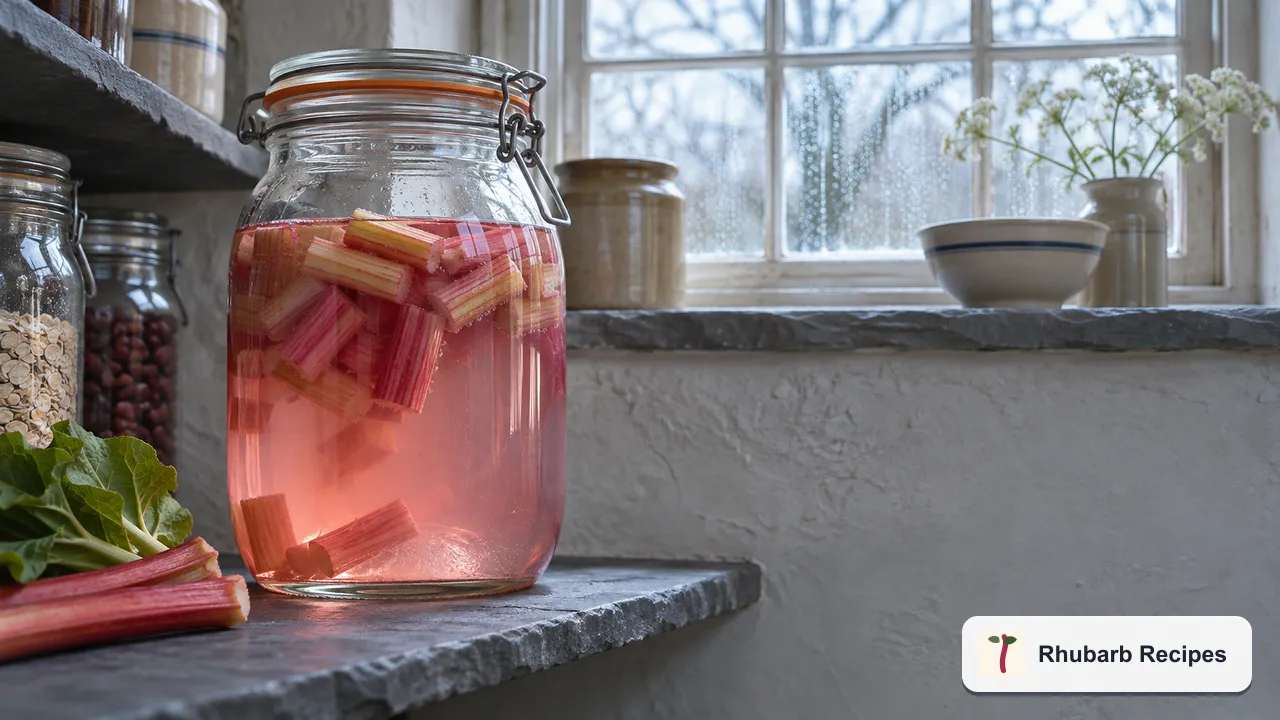
Rhubarb gin is one of the easiest homemade presents there is, and mid-November is the right moment to start a batch for Christmas. You need about 500 g of rhubarb, 200 to 250 g of caster sugar and a 70 cl bottle of ordinary London dry gin. Put the lot in a large clean jar, shake it every day until the sugar dissolves, and strain it after three to four weeks. That gives you a pink, sweet-sharp liqueur ready to bottle in mid-December.
What you are doing here is steeping, sometimes called infusing or macerating. The alcohol comes from a bottle you bought, with duty already paid, and the fruit and sugar simply flavour it. That distinction matters, and we come back to it below.
The recipe
Rhubarb gin
Makes about 900 ml · prep 10 min · steeping 3 to 4 weeks
- 500 g rhubarb, trimmed and cut into 2 cm pieces (frozen works well)
- 200 to 250 g caster sugar
- 70 cl gin, a plain London dry rather than anything already flavoured
- Optional: a strip of orange peel, a few slices of root ginger, or half a vanilla pod
- Use a clip-top or screw-top jar of at least 1.5 litres. Wash it in hot soapy water and rinse well.
- Put the rhubarb in the jar and tip the sugar over it. Close the lid and shake. Leave for a day; the sugar will start pulling juice out of the fruit.
- Pour in the gin, add any flavouring, seal and shake again.
- Keep the jar somewhere cool and out of direct light. Shake it daily for the first week, then every few days.
- After three weeks, taste. When the colour is a clear pink and the flavour is fruity rather than raw, strain through a sieve lined with muslin into a clean jug, then funnel into bottles.
Frozen rhubarb is the secret
In November, frozen rhubarb is all most people have, and it happens to be the better choice. Freezing breaks the cell walls, so the juice and colour leak into the gin much faster than from fresh stalks. If you have red-stemmed stalks in the freezer, use those for the prettiest colour. Greener stalks give a paler, more amber result that tastes just as good.
When the first forced rhubarb arrives in January you can make a second, very pale pink batch; see our piece on the Rhubarb Triangle for where those stalks come from. For a gift this year, though, the freezer is your friend.
Sugar: how much is right
Sugar does two jobs. It draws flavour out of the fruit, and it rounds off the acidity. With 200 g to a 70 cl bottle you get something closer to a fruit gin to drink with tonic. At 250 g or more it becomes a sipping liqueur for a small glass after dinner.
A sensible approach is to start with 200 g and adjust at the end. Dissolve a little extra sugar in an equal weight of hot water, let the syrup cool and stir it in a spoonful at a time until it tastes right. You cannot take sugar out once it is in.
The legal line: steeping yes, a still no
Flavouring a bottle of shop-bought spirit at home for your own use or as a present is ordinary kitchen practice. Making the alcohol yourself is a different matter. Producing spirits is controlled by HMRC, and the government’s page on the old distiller’s licence form explains that since 1 February 2025 new producers of alcoholic products must apply for an alcoholic products producer approval instead. In plain terms: if you are tempted by a small ‘gin still’ sold online, check the HMRC rules carefully before using it.
Selling alcohol is also a regulated activity, with licensing that sits outside a kitchen-garden journal’s expertise. If you are thinking about selling bottles at a fair or online, talk to your local council’s licensing team and get proper advice before you start. Giving a bottle to friends and family is the simple, safe route.
Strength and units
Adding fruit and sugar dilutes the gin a little, but the result is still a spirit. It is easy to forget that when something tastes like a pudding. The NHS guide to calculating alcohol units gives the formula: strength (ABV) multiplied by volume in millilitres, divided by 1,000. It also notes that men and women are advised not to drink more than 14 units a week on a regular basis. A small glass of a sweet liqueur still counts, so pour accordingly.
We would not put an exact ABV on a label for homemade gin, because you cannot measure it accurately at home. ‘Made with gin’ is honest and enough.
Bottling and presenting it
- Bottles. Small swing-top bottles of 200 to 250 ml make better gifts than one big one. Wash them, rinse well, and dry in a low oven.
- Clarity. If the gin looks cloudy, strain it a second time through a coffee filter. It is slow but leaves a clear liquid.
- Labels. Write the contents and the month it was made. Add ‘contains alcohol’ even if it seems obvious; a child or a non-drinker may pick it up.
- Posting. Carriers have their own rules for spirits and glass. Check your carrier’s restricted items list before you wrap a bottle for the post, or deliver it by hand.
Do not waste the fruit
The strained rhubarb is soaked in gin and very sweet. Spoon it over vanilla ice cream, fold it into whipped cream for a quick grown-up fool, or bake it under a crumble topping with a handful of fresh stalks. Remember it is boozy: keep it for the adults.
A timetable for Christmas
Start by 20 November and you can strain around 11 December, which leaves time to bottle, label and hand it over before the holidays. Started later, it will still be drinkable by Christmas but on the thin side; give those bottles with a note to save them for the new year. Most rhubarb gin keeps well for a year in a cool cupboard, although the bright pink fades to a softer rose after a few months. That is normal and does not affect the flavour.
Keep one bottle back for yourself. By the time maincrop rhubarb comes again in spring, you will know exactly how you want next year’s batch to taste.