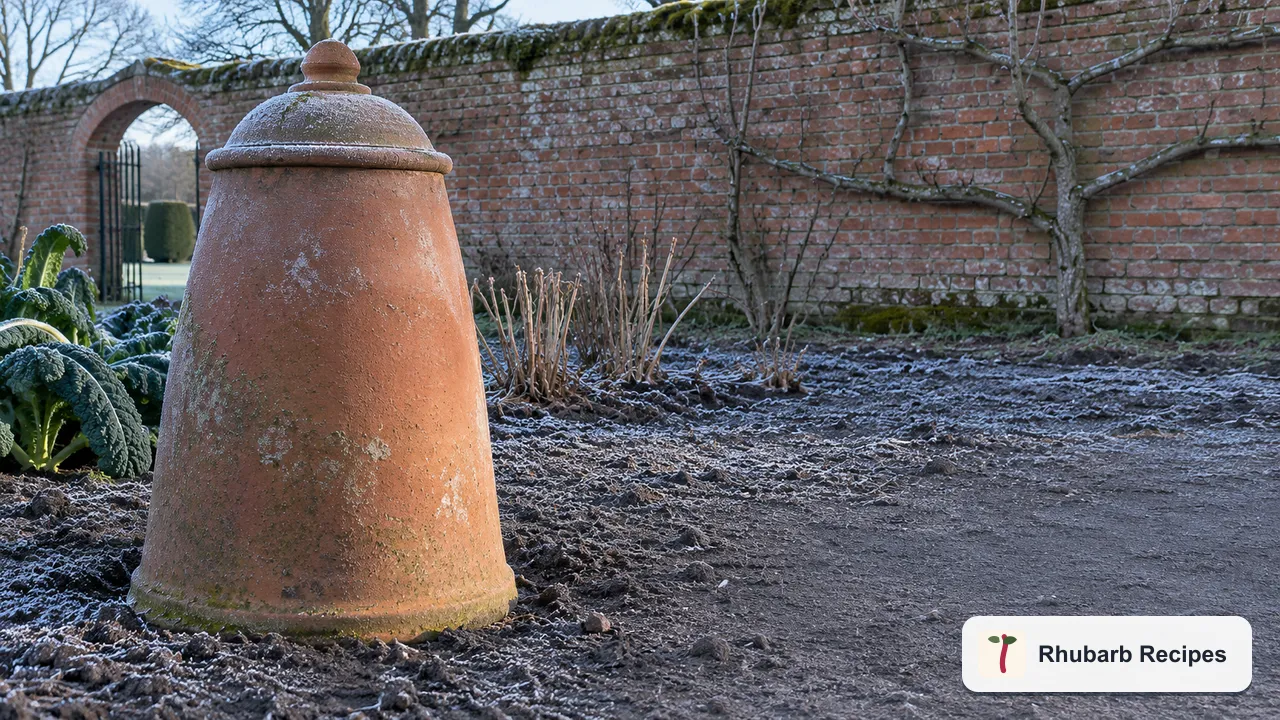
There are two ways to force rhubarb at home. The gentle one is to cover a healthy crown in the garden in midwinter with a forcing pot, a tall bucket or an upturned dustbin; tender pink stalks are ready four to eight weeks later. The faster one is to lift a crown in November, leave it outside for up to two weeks to get a chill, then pot it and keep it in the dark indoors at 7 to 16 °C; stalks are ready in about five weeks, but the crown is usually spent afterwards.
Both methods come from the RHS guide to growing rhubarb. They give you the same kind of stalk: long, pale, pink and much more tender than the outdoor maincrop. The difference is what each one costs the plant.
Why forcing works
A rhubarb crown stores energy in its thick roots over summer. After a period of winter cold it is ready to grow again, and in complete darkness it pushes up stalks using only that stored energy, without leaves to make more. The stalks stretch towards light that never comes, staying thin-skinned and pale. Commercial growers in the Rhubarb Triangle do the same thing on a grand scale in long, dark sheds.
The catch is obvious once you see it: the crown is spending its reserves and not refilling them. That is why forcing has to be done with strong plants and not too often.
Method one: forcing in the garden
This is the method most home growers use, and the one to try first.
- Choose the plant. It needs to be well established, at least three years old, and healthy. An early variety helps; the RHS recommends ‘Timperley Early’ as ideal for forcing.
- Clear around it. Remove dead leaves and debris from the crown. Slugs love to hide under forcing covers, so this is a good moment to deal with them.
- Cover it in midwinter. Place your forcing pot, bucket or dustbin over the crown, so no light gets in at all. Block the drainage hole of an upturned bucket or pot with a stone or tape.
- Insulate if you like. Packing straw or dry leaves around the outside of the cover keeps the inside a little warmer and brings the crop on faster.
- Wait. Peek every week or so. The RHS says stalks are usually ready four to eight weeks after covering, when they are about 30 cm long.
- Pull, then uncover. Pull the stalks as you would maincrop rhubarb, with a twist at the base. After the first flush, take the cover off and let the plant grow normally.
A traditional clay forcing pot with a lid looks lovely, but a black plastic dustbin does exactly the same job. What matters is height and total darkness.
Method two: lifting and forcing indoors
This gives the earliest crop and suits a crown you were going to replace anyway, or a spare piece from a division.
- In November, dig up a strong crown with as much root as you can.
- Leave it on the soil surface outside for up to two weeks. The cold exposure is what triggers it to grow once brought in.
- Pot it in a large container of peat-free multipurpose compost.
- Move it somewhere dark with a temperature of 7 to 16 °C, such as a cool spare room, cellar, garage or greenhouse with the pot covered. The RHS stresses excluding all light.
- Keep the compost only slightly moist. Too wet and the crown will rot.
- Stalks can usually be cut in about five weeks.
The RHS is frank that crowns forced this way are significantly weakened and are usually thrown away afterwards. Plan on that rather than hoping to nurse it back.
Looking after a forced crown afterwards
After garden forcing, the plant needs a long rest. The RHS advice is not to force the same plant in consecutive years. In practice that means:
- Do not pick any more stalks from it that spring once the forced crop is finished.
- Let the leaves grow freely all summer to rebuild the root.
- Give it a generous mulch of well-rotted manure or compost around, not over, the crown.
- Leave it alone the following winter, and force a different plant instead.
If you have three or more crowns, you can run a simple rotation: force one each winter, so each plant gets two years off between turns.
Problems you may meet
Slugs. The RHS notes that slugs and snails can damage young shoots, especially under forcing covers. A torchlit check under the pot every few days catches them.
Rot. A damp, airless cover over wet soil can encourage the crown to rot. Make sure the ground drains freely before you start, and do not water a forced crown in the garden.
Nothing happening. Usually the plant is too young, too weak, or covered too early, before it has had enough cold. Leave the cover on a few more weeks, or try a different crown next year.
Using forced stalks in the kitchen
Home-forced rhubarb cooks very quickly and keeps its colour, so treat it gently. Poach it in a light syrup for three or four minutes, roast it briefly on a tray with a little sugar and orange, or slice it raw into thin ribbons for a sharp salad garnish. Long cooking turns it to pink mush. For more on the difference between the two kinds of rhubarb, our growing notes and the piece on the rhubarb year set out how each season’s stalks behave.
For a first attempt, choose your strongest crown, cover it after Christmas, and look forward to a bowl of pink stalks in February when nothing else in the garden is ready.