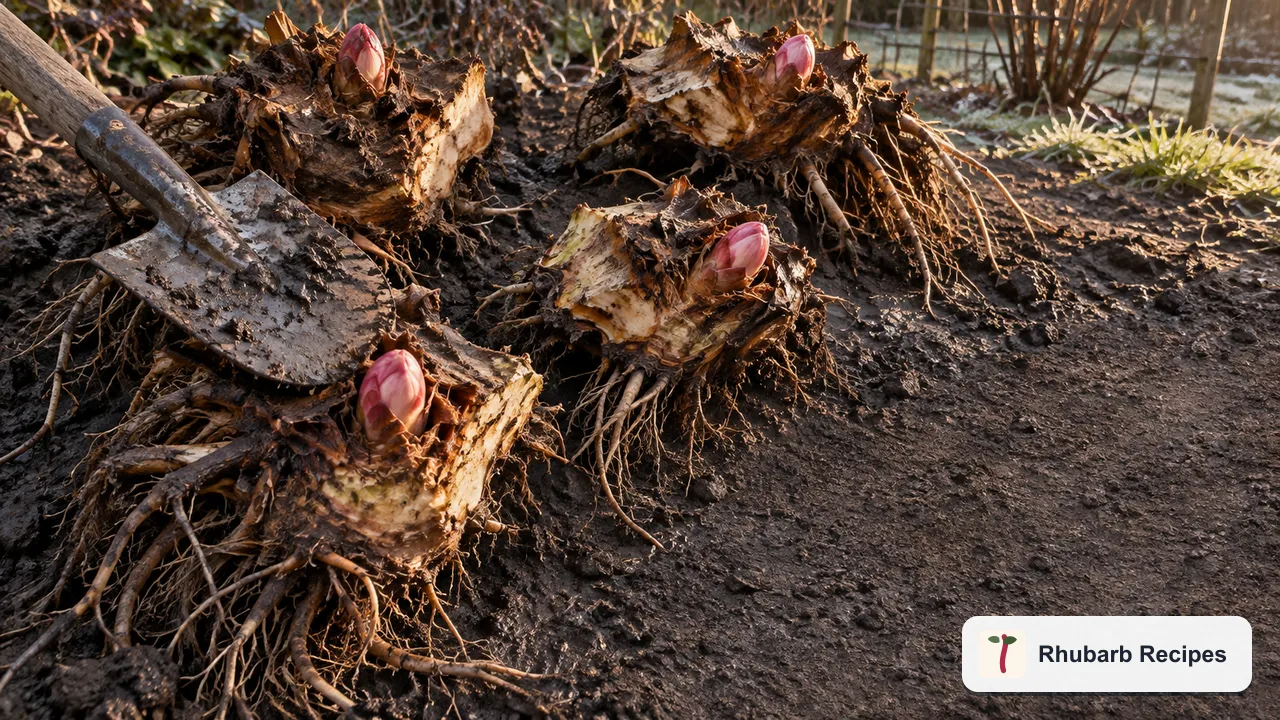
Divide rhubarb while it is dormant, between mid-autumn and early spring, roughly once every five years or whenever an old clump starts producing thin, weak stalks. Dig up the whole clump, cut it into pieces that each have a chunk of root and at least one bud, keep the vigorous outer pieces, throw away the woody centre, and replant straight away.
That is the job in a sentence. It takes about half an hour per clump and costs nothing. Done every few years, it keeps a rhubarb bed productive more or less indefinitely, and you end up with spare crowns to give away.
Signs a clump needs splitting
A rhubarb plant does not need dividing on a strict timetable. Look for these signs instead:
- The stalks have become noticeably thinner and shorter than they used to be.
- There are lots of buds crowded together, all producing spindly growth.
- The middle of the clump has gone hollow or dead, with growth only around the edge.
- The plant has started throwing up flower spikes every year, even when you remove them.
- It has been in the same spot, untouched, for five years or more.
The RHS rhubarb guide suggests dividing large clumps about every five years, or when they become overcrowded or less vigorous. If your plant is still giving thick, healthy stalks after six years, there is no need to disturb it.
When exactly
The window is the dormant season, from the time the leaves have collapsed in autumn to just before the buds start to swell in late winter. November and December are pleasant months to do it: the soil is usually still workable, and the crown has the whole winter to settle before it has to produce leaves.
Avoid days when the ground is frozen hard or waterlogged. Digging in sticky clay damages soil structure, and a split crown left sitting in a puddle is an invitation to rot. Pick a dry, mild spell.
What you need
- A sharp spade, and a fork to help lever the clump out.
- A sharp, sturdy knife or a pruning saw for the tougher sections.
- A wheelbarrow or tarpaulin to work on.
- Well-rotted manure or garden compost for replanting.
- Labels or canes to mark where the new pieces go.
Step by step
- Clear the top. Pull away the dead leaves and any weeds so you can see where the buds are. They look like fat pink or red knobs at soil level.
- Dig around it. Push the spade in vertically in a circle about 20 to 30 cm out from the crown. Rhubarb roots are thick and deep; you will cut some, and that is fine.
- Lever it out. Work the fork underneath and lift the clump onto the tarpaulin. An old clump can be very heavy, so lift with your legs and get help if you need it.
- Read the clump. Brush or hose off enough soil to see the structure. You will usually find a dense, woody, sometimes rotten centre surrounded by younger, firmer sections with healthy buds.
- Cut it up. Using the spade or knife, divide the clump into pieces. Each piece needs a good section of root and at least one strong bud. Fist-sized is about right; bigger pieces establish faster.
- Be ruthless with the middle. The RHS advises using the outer sections rather than the centre of old plants, and discarding anything weak or decayed. Old, woody heartwood rarely makes a good plant.
- Replant at once. Each piece goes into ground enriched with compost or manure, with the bud just at or slightly above soil level, 75 to 90 cm apart.
If you cannot replant straight away
The RHS says divided sections can be wrapped in damp sacking for a short time if they cannot go back in immediately. Keep them somewhere cool and shaded, such as a shed floor, and check they have not dried out. A few days is fine. A few weeks is pushing it.
Choose a fresh site if you can
Putting new divisions back into exactly the same hole is not ideal. The soil there has fed a hungry plant for years, and if any of the old crown was rotten, the problem may linger. If you have the space, plant the best divisions in a new bed and use the old site for something else for a few years.
Where space is tight, dig out the old soil from the planting hole and refill with fresh topsoil mixed generously with compost.
Mulching after division
Once the pieces are in, spread a mulch of well-rotted organic matter around them. The RHS page on mulches recommends a layer of at least 5 cm and says to put it down over moist soil, not frozen ground. Keep it off the buds themselves; a bud buried under wet compost is more likely to rot.
What to expect next year
A division behaves rather like a newly planted crown. Treat the first season as a recovery year and do not pull any stalks, or at most one or two from the biggest piece late in spring. In the second year you can pick lightly; by the third, the new plants should be as productive as the old one was in its prime. Our guide to growing rhubarb from a crown covers this establishment period in more detail.
Do not try to force a freshly divided piece this winter. Forcing draws heavily on the stored energy in the root, and a new division has none to spare.
What to do with the spare pieces
An old clump can easily yield six or eight good divisions. Few gardens need that many. Friends, neighbours and allotment holders are usually delighted to take one; pot spares up in a large container of compost to hold them for a few weeks. A spare piece is also worth trying in a big pot on the patio if you want rhubarb close to the kitchen door.
Splitting an old clump is one of those winter jobs that feels like hard work on the day and pays you back for years. Set aside a dry morning in November or December, and next spring’s picking season will look after itself.